


You've seen the face. The lip. The hands going over the ears before the sound has even started.
Your child is sitting in front of an "educational" app. They were doing fine. Matching shapes. Sounding out letters. Engaged. Calm. Learning.
Then the timer appeared. A red countdown bar. Shrinking. Flashing. Three... two... one... WRONG. A buzzer. A vibrating screen. A sad face emoji. A score in red.
And your child, who was learning thirty seconds ago is now frustrated, crying. Or shutting down. Or throwing the tablet. Or going completely still in a way that scares you more than the crying.
That wasn't a glitch. That was the product working exactly as designed.
The "Urgency Engine"
Here's what most parents don't know about the educational apps on their child's tablet.
The red alert. The countdown timer. The flashing "wrong answer" screen. The pressure bar that fills up as time runs out. These aren't pedagogical choices. They're engagement mechanics borrowed directly from the gaming industry and repackaged as "learning tools."
The industry calls it "gamification." We call it the "Urgency Engine."
The logic is simple: pressure creates engagement. A child under time pressure clicks faster, plays longer, completes more sessions. The metrics look brilliant on a quarterly report. Retention is up. Session duration is up. "Learning events" are up.
But here's what the metrics don't measure: cortisol.
The Science: Red Means Danger. Literally.
This isn't opinion. It's physiology.
Research by Kutchma (2003) at Minnesota State Colleges and Universities found that subjects in red environments recorded significantly higher stress scores on the Depression, Anxiety and Stress Scale compared to those in green or white environments. The colour red doesn't just look urgent, it triggers a measurable biological response.
Dr. Mary Poffenroth, Ph.D., a neuro-hacking biopsychologist, puts it bluntly: red activates the sympathetic "fight or flight" response, causing increased heart rate, elevated blood pressure, faster respiration, and heightened muscle tension. For individuals with anxiety, and that includes a significant proportion of neurodivergent children; these physiological responses are experienced as threatening sensations.
Now think about what we're doing. We're putting a red countdown bar on a screen twelve inches from a seven-year-old's face. We're flashing it. We're adding a ticking sound. We're penalising them when it reaches zero.
We're not teaching them. We're triggering them.
And for neurodivergent children, the impact is exponentially worse.

Take Sophie. Take Liam.
Sophie is seven. Lives in Leeds. Autistic. She's a visual thinker, she processes the world through patterns, sequences, and spatial relationships. Her visual processing system is extraordinarily sensitive. What a neurotypical child registers as a "colourful timer," Sophie's nervous system registers as a sensory assault.
Research by Ashburner, Ziviani & Rodger (2008) in the American Journal of Occupational Therapy found that sensory processing differences directly impact classroom emotional regulation, behaviour, and educational outcomes in children with autism. The sensory environment isn't background noise for Sophie. It's the foreground. It determines whether she can learn at all.
When a red alert flashes on Sophie's screen, her amygdala fires before her prefrontal cortex has even registered the question. She's not thinking about the answer anymore. She's in survival mode. The app has biologically removed her ability to learn in the exact moment it's supposed to be teaching her.
Now take Liam. He's nine. ADHD. His executive function, the ability to plan, sequence, and manage time is already running on reduced bandwidth. Liam doesn't experience time the way neurotypical children do. Research by Poole, Gowen, Poliakoff & Jones (2021), published in Autism, identified that neurodivergent children face significant difficulties with time perception, transitioning between activities, and understanding abstract temporal concepts.
Dr. Emily W. King, a child psychologist specialising in neurodivergent children, describes watching children put their hands over their ears at the mere sight of a timer, not because of the sound, but because of the anticipation of the sensory experience when time runs out. The anxiety isn't about getting the answer wrong. It's about the countdown itself.
She observed a child with ADHD and anxiety using an educational app. The child was performing brilliantly, identifying words, spelling accurately, fully engaged. Then the next level introduced time pressure: words falling from the top of the screen. Under pressure, the child began selecting incorrect answers; scrambling letters, making errors she wouldn't have made without the countdown. The timer didn't improve her performance. It destroyed it.
The app measured that as "engagement." The child experienced it as failure.
The Design Crime
Here's the uncomfortable question. If we know that red light activates the fight-or-flight response. If we know that countdown timers collapse working memory in children with ADHD. If we know that flashing visual alerts overwhelm the sensory processing systems of autistic children. If we know that time pressure increases cortisol and decreases cognitive performance in developing brains...
Why is every "educational" app on the market still built around red alerts and countdown timers?
Because the apps aren't designed for your child's nervous system. They're designed for your child's attention. And those are two completely different things.
Attention is a metric. It shows up in dashboards. It satisfies investors. It renews subscriptions.
A regulated nervous system doesn't show up in any dashboard. But it's the only state in which real learning can actually occur.
The Squad Solution: The Sensory Safe Harbour
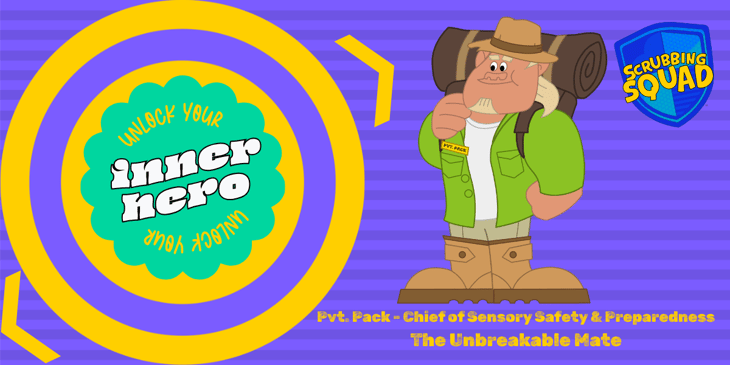
This is why we built the "Sensory Safe Harbour" protocol, and it's why Pvt. Pack exists.
Pvt. Pack is our Chief of Sensory Safety. His mandate is non-negotiable: the digital environment must never assault a child's nervous system. Not accidentally. Not for "engagement." Not ever.
Here's what that looks like in practice.
1: The Red Ban. Our UI does not use red for alerts, errors, or time indicators. Full stop. No red countdown bars. No red "wrong answer" screens. No red flashing notifications. We use calm, low-saturation colour palettes optimised for neurodivergent visual processing, high contrast where needed for accessibility, but never high arousal. Designers working in mental health spaces already know this: you avoid reds and yellows entirely because their physiological effects worsen anxiety in people experiencing emotional distress. We've applied clinical design standards to a children's platform. Because children deserve them.
2: The Timer Ban. We do not use competitive countdown timers. Time pressure is not a learning tool. It's a stress generator. Instead, our Sovereign Brain tracks effort over time, not speed within time. A child who takes forty-five seconds to identify the right answer has demonstrated mastery. A child who guesses in three seconds under pressure has demonstrated nothing except cortisol.
3: The Pace Protocol. Every child moves at their own speed. The Sovereign Brain adapts in real time, not to push faster, but to calibrate difficulty to the child's demonstrated capacity. Pvt. Pack's protocol includes sensory-friendly defaults: no autoplay audio, moderate animation, clean uncluttered interfaces, and a single instruction at a time. If the system detects sustained high engagement beyond twenty minutes, Sgt. Keith's Green Eject fires, the screen locks, the session ends, and the child is sent into the physical world.
4: The Hero Readiness Vest provides deep-pressure sensory regulation before and during missions, the weighted, tagless, flat-seamed wearable that helps Sophie's nervous system settle before she even picks up a device. The Signal Kit gives Liam non-verbal tools to communicate "I need a break" without having to find the words under pressure.
And the Hero Beacon manages screen-to-world transitions with a calming green pulse and haptic heartbeat, replacing the jarring alarm with a physiological signal that says "well done, time to go."
For Schools and Institutions
If you're a SENCO or a Trust leader, here's your question: Does your current EdTech platform use red alerts, competitive countdown timers, or flashing error screens?
If yes, you are running software that clinical research shows triggers fight-or-flight responses in neurodivergent children. You are paying for a product that biologically prevents a proportion of your cohort from learning while they're using it.
Our Administrative Shield provides Ofsted ready evidence that your digital environment meets neuro-inclusive design standards. The Evidence of Effort ledger doesn't measure speed. It measures mastery, verified, individualised, and calibrated to each child's sensory and cognitive profile. That's not just good pedagogy. It's a defensible position when a parent asks why their autistic child came home distressed after using a "learning" app.
The Scrubbing Squad doesn't gamify anxiety. We engineer calm. And we can prove it.
The Bottom Line
Every red alert. Every countdown timer. Every flashing "WRONG" screen. Every pressure bar that punishes a child for thinking carefully instead of clicking fast.
These are design choices. And they are the wrong ones.
Your child's nervous system is not a dashboard metric. Their cortisol is not "engagement." Their tears are not "learning friction."
We banned the red. We banned the timer. We built a platform where the first design constraint isn't "how do we keep them on screen?" but "how do we keep their nervous system safe while they're here?"
Because a regulated child can learn anything. And a dysregulated child can learn nothing — no matter how many red buttons you flash in their face.
Building for 10 million heroes.
Heroes Start Here
Join the hero community: Sign up at scrubbingsquad.com and be the first to get exclusive access for your Heroes.