


You're in the supermarket. It's 6pm. The kids are with you because after-school club costs £13 a day and that's £66 a week you don't have.
You need washing powder. The big box, the one that works out at 8p a wash costs £9. You have £7.60 until Friday. So you buy the small box. The one that costs £3.99. The one that works out at 19p a wash.
You just paid more than double per wash. Not because you're bad with money. Because you're poor.
And this this tax on not having enough follows your family into every corner of your life. Energy. Insurance. Credit. Food. Transport. And now, the thing that should be the great equaliser: your child's education.
Welcome to the Poverty Premium. The most brutal hidden cost in Britain. And nobody's talking about what it's doing to your kids.
What Is the Poverty Premium?
The Poverty Premium is a well-documented economic phenomenon: low-income families systematically pay more per unit for the same essential goods and services than wealthier families.
Not slightly more. Significantly more.
Research by the The University of Edinburgh, published in Energy Economics (2024), found that poor households paid between 10 to 20 per cent more per unit than higher income households for both gas and electricity between 2011 and 2019. That's not a choice. It's structural. Households using non-standard billing methods such as prepayment meters, with children and unemployed adults, are likely to pay more for energy and incur higher premiums. Source: ScienceDirect
The University of Bristol's Personal Finance Research Centre calculated the average cost of the Poverty Premium at £490 per low-income household per year. And for the most exposed families? One "highly exposed" family is estimated to incur a premium of £1,680 per year.
Energy. Insurance. Fuel. Credit. Telecommunications. In every category, the pattern is the same: the less you have, the more you pay to access the basics.
But here's where it gets personal. Here's where it walks through the front door and sits down next to your child at the kitchen table.
The Education Poverty Premium
Every "premium" EdTech platform on the market operates the same model. Monthly subscription. Dedicated device. Stable broadband. Ongoing content packs. Companion hardware.
For the family earning £75,000 with two iPads and fibre broadband, this is frictionless. A £12.99/month subscription is noise. An "expansion pack" at £29.99 is an impulse buy.
For the family on Universal Credit with a shared smartphone and a pay-as-you-go data plan? That £12.99/month is a meal. And the "free tier" they're offered in place of it is the ad-supported, data-harvesting, feature-stripped version and isn't the same product. It's a lesser product. Designed to be lesser. Priced to remind you that you're lesser.
This is the Education Poverty Premium. And it works exactly like the prepayment meter.
The family who can't afford the bulk deal pays more per unit. The family who can't afford the annual subscription pays more per month. The family who can't afford the device pays more in data, battery life, and frustration. And the child at the centre of it, the one who didn't choose any of this receives a measurably inferior developmental experience. Not because they're less capable. Because their parents are less wealthy.
The UK government's latest statistics are forensic on this point. 4.5 million children, some 31% are in relative low income after housing costs. In a typical classroom of 30 children, ten children are in relative low income. GOV.UK And for two million of those children, the government's own deep material poverty metric shows their families cannot afford things like keeping their home adequately warm, fresh fruit and vegetables every day, and age-appropriate toys. GOV.UK
Age-appropriate toys. The government measures whether families can afford toys. And two million children's families can't.
Now tell me those families are buying a £200/year EdTech subscription.
Take Ama. Take Zara.
Ama is eight. Rural Volta Region, Ghana. She's the village storyteller, the child who preserves elder wisdom through narrative. She has access to community WiFi sometimes. Electricity is intermittent. A tablet is a shared resource across multiple families.
Every premium EdTech product requires a dedicated device, stable broadband, and a monthly subscription. Ama doesn't exist in their user model. She's a rounding error in someone else's TAM slide.
Now take Zara. Ten years old. Low-income immigrant family. Her family has limited financial resources. They rely on free apps and services, which, as our own research documents, typically have weaker privacy protections and more aggressive data collection practices than paid alternatives. Zara's family shares devices among multiple members. They rely on public WiFi at libraries and community centres.
Zara doesn't pay the Poverty Premium in cash. She pays it in privacy. Her data is the product. Her attention is the revenue model. And the "educational" content she receives in exchange is the stripped-down, ad-riddled version that the platform would never show an investor's child.
Two children. Two continents. Same structural extraction.
Why "Free Tier" Is the New Prepayment Meter
Let's be forensic about this comparison. Because it's exact.
A prepayment meter charges you more per unit of energy. You know this. The industry knows this. The University of Edinburgh proved it. But the meter stays because the alternative, letting low-income families access the same tariff as everyone else would require the provider to absorb the risk. And they won't.
The "Free Tier" of every major EdTech platform operates on identical logic. The free version isn't generosity. It's a different product with a different economic model.
- The paying customer gets the curriculum. The free customer gets the advertising.
- The paying customer's data stays private. The free customer's data gets sold.
- The paying customer's child experiences a calm, ad-free learning environment. The free customer's child experiences interruptions, upsells, and attention-harvesting mechanics.
The child on the free tier isn't learning less because they're less smart. They're learning less because the product was deliberately degraded to make them worth monetising through a different channel.
That's the Poverty Premium. Applied to a child's brain. At age seven.
The Squad Solution: The Poverty Lock
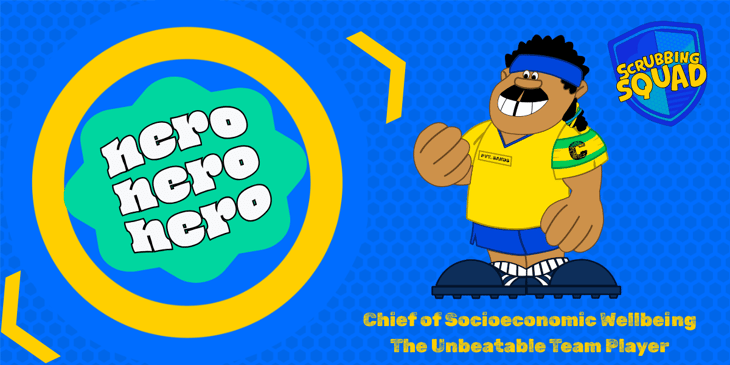
This is why Pvt. Sands exists. He's our Chief of Socioeconomic Wellbeing. The kid from the favela who understands that poverty isn't a character flaw; it's an infrastructure failure. And infrastructure failures get engineered out. Not donated around.
The Poverty Lock is our answer. Not a charity initiative. Not a corporate responsibility slide. A structural, algorithmic mandate hard-coded into our unit economics.
When we sell a premium Mission Vessel via our own Sovereign Rail, as a 'phygital' product we bypass the 30% platform tax that Apple and Google impose on digital transactions. That recaptured margin is ring-fenced as Impact Capital. It doesn't go to shareholders. It doesn't go to marketing.
The formula: for every five premium units sold to an affluent family, the recaptured margin funds the manufacturing cost of one identical unit, same quality, same materials, same NFC encryption, same curriculum access, distributed to a child in a low-resource setting through the Unlocking Heroes Foundation.
Yes we said, identical - and we do not manufacture a "free tier" for poor children. We do not strip features. We do not degrade the product. We do not harvest data as a substitute for revenue. The unit that goes to Ama in Ghana is the same unit that goes to a family in Kensington. Because the moment you build two versions, one for the rich and one for the poor, you've built the prepayment meter into a child's education.
And we refuse.
The University of Bristol research made a crucial point that most people miss: the Poverty Premium only reflects the additional costs low-income households pay. It doesn't take into account the extent to which low-income households avoid paying poverty premiums simply because they can't afford to and instead go without.
Going without. That's the silent line. The family that doesn't buy the EdTech subscription at all. The child who has no digital learning tool, not even the degraded free version. The invisible child. The one who doesn't show up in anyone's engagement metrics because they were never on the platform in the first place.
The Poverty Lock is built for that child. Not as an afterthought. As the starting point.
For Schools and Institutions
If you're a Head Teacher or a Trust leader, the Poverty Premium is already in your building. It's in the apps your Pupil Premium children use versus the ones your fee-paying after-school-club children use at home. It's in the device gap. It's in the broadband gap. It's in the gap between the child whose parents pay for the "premium" version and the child whose parents can't.
Our architecture doesn't require a dedicated device. Our NFC hardware works offline. Our Sovereign Brain stays local, no cloud dependency, no broadband requirement. And the Evidence of Effort data it generates is identical regardless of whether the child's family paid full price or received a subsidised unit through the Foundation.
For your institutional partners and corporate sponsors, the Poverty Lock provides forensic social impact ROI. Not "we donated to a school." Instead: "Your purchase of 100 kits funded 33 identical kits for families in deep material poverty, and here is the verified developmental outcomes data."
That's not a grant report. That's an Administrative Shield. Ofsted proof. Audit-ready. And structurally incapable of building a two-tier system.
The Bottom Line
The Poverty Premium is real. It's documented. It costs low-income families hundreds of pounds a year in energy alone. And the EdTech industry has replicated it perfectly charging the poorest families the highest price, not in cash, but in privacy, degraded products, and developmental inequality.
We think that's broken. And we don't think the answer is "donate a few free licences." The answer is engineering a business model where a two-tier system is structurally impossible.
One product. One quality. One standard. Regardless of postcode, income, or how you pay your gas bill.
Your child's developmental destiny shouldn't cost more because you have less.
Building for 10 million heroes.
Heroes Start Here
Join the hero community: Sign up at scrubbingsquad.com and be the first to get exclusive access for your Heroes.

.png)