

The Three Seconds That Save the Whole Day
Ask any parent of a child on the autism spectrum what happens when a screen turns off without warning.
They will not need a study to answer.
They will tell you about a meltdown. The afternoon written off in the half second between an app being open and an app being closed.
Most children's apps fade to black in five hundred milliseconds. Half a second. Quicker than the brain can register the change. For some children that is invisible. For Emma's daughter Sophie, it is a sensory cliff.
The day collapses behind it.
We built our off-switch to take three seconds. Always exactly three. The same gentle dim every single time, on every single device, after every single mission.
That decision is the whole product.
This Is Not Accessibility
The category word for what we built is accessibility.
That is not what we built.
Accessibility is what gets added at the end. A larger font. A captioned video. A tick box on a compliance form. Accessibility is the apology after the architecture is already done.
What we built is called Ace Mode.
Ace Mode is not the accessible version of our app. It is the version we designed first. The version every other mode is measured against.
We did not start from the neurotypical child and engineer downwards. We started from the child the rest of the industry forgets, and engineered outwards.
That is the SEND-first principle. Not SEND-accommodating. SEND-first. The child who needs the most predictable, the most sensory-safe, the most adaptive experience is not a special case. The child is the design standard.
The Off-Switch Tells You Everything
The off-switch is the cleanest tell in software design.
If a children's app makes leaving the screen difficult, you know the rest of it is built to keep your child on the screen. The exit was an afterthought. The retention came first.
If a children's app makes leaving the screen graceful, you know the team thought about the moment after.
For most children, the moment after is a snack and a question.
For Sophie, the moment after is the entire afternoon.
We took the off-switch seriously because Sophie cannot afford for us not to.
What Ace Mode Actually Does, in Plain Language
A parent does not need a clinical specification. A parent needs to know what changes when their child uses our platform.
The colours quieten. We use a flat Baker-Miller Pink background. It is the calmest visual field we could find for a screen that needs to recede, not perform.
The animations slow or stop. Visual density drops. Touch targets grow to forty-eight pixels minimum. A child does not have to aim.
Visual supports stay on. PECS picture cards stay visible at all times. They are not a setting Emma has to remember to turn on. They are simply there.
Audio never autoplays. Sound only happens when the child asks for it. The screen never surprises Sophie.
The screen also lets her go gently. Three seconds, not half a second. The same fade every time. The same warning before the fade. The same predictability the visual schedule on her bedroom wall already taught her she could trust.
For children who do not speak, our Hero Beacon ends a session through vibration and light cues alone. No voice instruction is required. The body knows. The mission ends. The world resumes.
Take Emma
Emma is a part-time teacher and a full-time care coordinator. Her daughter Sophie is five, nonverbal, and lives by visual schedules.
Emma does not need another app that promises to be sensory-safe. She has tried those. She has the receipts.
She needs a system that does not break when her partner James uses it on Saturday morning. Or when Grandma Linda steps in for a respite afternoon. Or when school sends a different visual cue home in Sophie's bag.
She needs the same exact sequence on every device, in every hand.
We built that.
The technical name is a Solid Pod for Sophie's sensory profile. The plain English version is this: Sophie's profile follows her. Same colours, same sounds, same off-switch, same exact rules. On Mum's phone. On Dad's phone. On Grandma's tablet. On the school's class device.
It cannot be broken by accident. Three months of routine cannot be reset by one well-meaning tap on the wrong button.
And Take Sarah
Sarah is the parent of a seven-year-old who is, on paper, neurotypical.
She still feels the six o'clock meltdown.
She still watches her son's nervous system fall apart when an app ends a session badly.
The truth is that every child benefits from the standards we built for Sophie. The three-second fade. The lower visual density. The respect for transitions. None of these are SEND-only design choices.
They are how children's software ought to be built.
We started with Sophie. The rest of the platform inherited her standards. Sarah's son gets the benefit of a design system that was costed for the hardest case first.
A Word for the Buyers Reading
For the SENCO who arrived here through a parent's share: the platform produces a forensic, timestamped record of every visual sequence a child completed. EHCP review evidence does not start with memory. It starts with the ledger.
For the media slate readers and sponsorship leads: SEND-first is not a niche. It is the IP architecture. Every Squad member, every mission, every Vanguard product was costed against this standard before a single asset was built. This is what licensable inclusion looks like at the engineering layer, not the marketing layer.
Pvt. Ace and the Promise
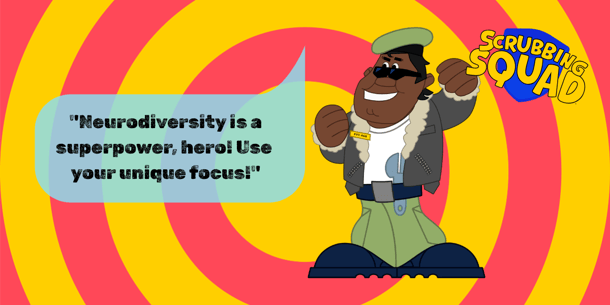
Ace Mode is named for Pvt. Ace.
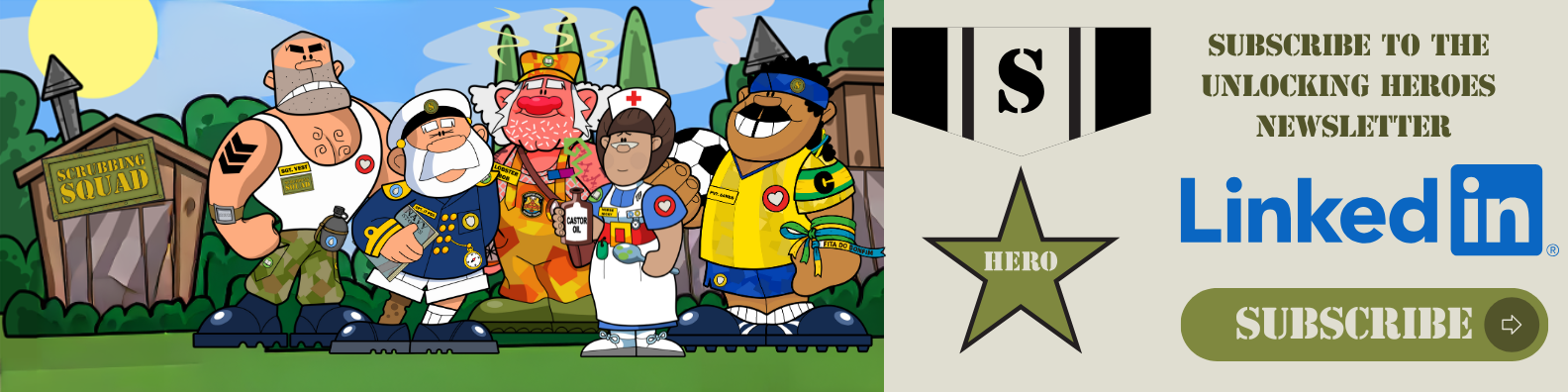
He grew up in Lagos, Nigeria. Chief of Neuro-Inclusive Learning. The High-Energy Motivator. Trained to move at one speed and recalibrated to move at the speed of the child in front of him.
His promise to the heroes he serves is the simplest line in the Character Bible.
If it is stopped, he will start it. If they cannot learn it the standard way, he will teach it better.
That is the brief. It is also the engineering specification.
What Comes Next
Next Monday the Squad meets Sgt. Rose. Hygiene pillar. Indian. Chief of Personal Hygiene. The dignity champion.
The Shopify merch store opens this month of May 26. Character-led, not product-led. More on that next week.
But the work this week is the work that sits underneath everything else. Ace Mode. The off-switch built first. For Sophie. For Rustam. For Aibek. For every child the rest of the industry forgot to design for.
736 of you read this first, thank you for supporting and subscribing. The founding crew is still growing. Forward this to one parent who needs it.
Heroes Start Here.
Join the hero community: Sign up at scrubbingsquad.com and be the first to get exclusive access for your Heroes.
.png)