


As we move past the holiday season, many parents are noticing a strange phenomenon. The apps that enthralled their child just six months ago are suddenly being tossed aside with a frustrated "This is for babies."
This isn't just a change in taste. It’s a biological milestone we call the Age 7 Shift. It is the moment the "digital scaffolding" of early childhood must be completely rebuilt to support a new kind of hero.
The Hook: The Death of Digital Magic
For a 4-year-old, the world is a place of "magical thinking"—where a character on a screen is a real friend and a simple animation is pure wonder. But around age seven, a cognitive light switch flips. The magic is replaced by a demand for logic, cause-and-effect, and real-world mastery.
If your 7-year-old is "acting out" against their educational apps, it’s not a behavior problem; it’s a System Design Failure. They are outgrowing the architecture of their digital world.
The Evidence: From Preoperational to Concrete Logic
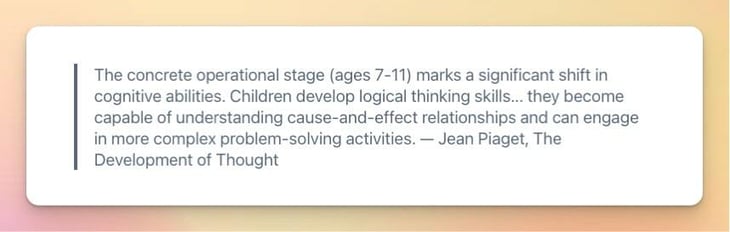
Our research Library, cross-referenced with global standards, identifies this as the transition from Piaget’s Preoperational stage to the Concrete Operational stage.
- The Attention Gap: A 4-year-old typically has an 8–12 minute attention span for structured activities. By age 7, this expands to 14–21 minutes, but only if the content provides immediate feedback and mastery challenges
- The Working Memory Leap: A 4-year-old can hold 2–3 pieces of information in their working memory. An older child can manage 5–6. Apps designed for the former feel insulting and "slow" to the latter.
- The "Feel of Learning" Fallacy: A landmark Harvard study proves that while children might prefer passive, easy content, they actually learn significantly more when engaged in "active learning" that challenges their new logical faculties.
Two Heroes, Two Worlds: John vs. Zahara
To see the shift in action, look at two of our 46 user personas:
- The "Magical" Hero (Below Age 7): John (Age 4, Glasgow). John is "The Little Wildlife Helper." He learns through sensory exploration and animal stories. For John, handwashing isn't a chore; it’s a mission to "protect the otters from germ villains". He needs larger touch targets and simple visual cues because his motor skills are still developing
- The "Logical" Hero (Above Age 7): Zahara (Age 11, Bristol). Zahara is "The Oral Oracle." As a dyslexic learner, she has moved past simple animations. She demands complex "Sheeko-style" narrative quests and tactile plot mapping. She doesn't want to be told what to do; she wants to decide the outcome of the mission through her own voice.
The Squad Solution: Pvt. Sky and the Adaptive Cockpit
To bridge this gap, we are varying our pedagogical approach. This week, we introduce Pvt. Sky (Chief of Emotional Safety),
Pvt. Sky isn't just a character; he is a Pedagogical Modality.
- For the "Johns": He uses his teddy bear, Joan, to teach that being scared is okay, using simple, high-repetition instructions that fit a 4-year-old’s "air traffic control" system.
- For the "Zaharas": He uses his background in high-stakes aviation to teach "Safe Landings"—a complex metaphor for emotional regulation that respects an older child's need for logic and personal responsibility.

Our Mission In Actio
We aren't building "just another app." We are building an Adaptive Hero Community that recognizes that a 7-year-old is a different biological being than a 4-year-old.
We are currently building this system for 10 million children to ensure that as they grow, their digital world grows with them. We don't just teach them to use a screen; we give them the compass to navigate the real world.
Heroes Start Here

Join the hero community: Sign up at scrubbingsquad.com and be the first to get exclusive access for your Heroes.
With gratitude,