


Something happened around your child's seventh birthday. You might not have spotted it. No announcement. No milestone card. No notification from the school.
But somewhere between six and seven, the way your child thinks changed. Fundamentally. Structurally. Permanently.
The tantrums that used to erupt from nowhere started to have reasons. The magical thinking ("if I close my eyes the broccoli disappears") gave way to something sharper. Questions got harder. Arguments got more logical. Negotiations at bedtime started sounding suspiciously like cross-examination.
Your child crossed a cognitive border. They moved from believing the world works by magic to understanding the world works by rules.
And the "educational" app on their tablet? Still flashing. Still beeping. Still treating them like a toddler who needs fireworks to stay engaged.
Your child upgraded. The product didn't.
The Concrete Operational Shift
In 1952, the Swiss psychologist Jean Piaget published one of the most influential frameworks in developmental psychology. He identified four stages of cognitive development. The third, which he called the Concrete Operational Stage, begins around age seven and lasts until approximately eleven.
This is not a minor adjustment. It is, as researchers at Psychology Notes HQ describe it, a cognitive watershed. At this stage, around ages 7 to 11, children can reason logically about tangible, physical objects and situations. They demonstrate skills such as conservation, reversibility, classification, seriation, and de-centration.
In plain English: your seven-year-old can now sort things into categories. Understand that pouring water from a short fat glass into a tall thin glass doesn't change the amount. Reverse actions in their head. See things from other people's perspectives for the first time.
The National Institutes of Health (StatPearls, 2023) confirm that in the Concrete Operational Stage, the child uses logical operations when solving problems, including mastery of conservation and inductive reasoning.
This is the moment a child stops needing flash and starts needing logic. They stop needing noise and start needing structure. They stop needing to be entertained into learning and start needing to be challenged into mastery.
And this is exactly the moment that most children's apps fail them.

The Flash Trap
Here's the problem. The majority of "educational" apps on the market are designed for one cognitive profile: the pre-operational child. The under-seven. The child who responds to bright colours, surprising sounds, and magical rewards. The child who needs spectacle because their brain cannot yet process logic.
That design makes sense for a four-year-old. It is developmentally catastrophic for a nine-year-old.
Hirsh-Pasek, Zosh, Golinkoff and colleagues (2015), in a landmark paper published in Psychological Science in the Public Interest, examined how children actually learn from apps. Their findings were devastating for the industry. They identified that children learn best when they are cognitively active, engaged, when learning experiences are meaningful and socially interactive, and when learning is guided by a specific goal. They called these the "Four Pillars of Learning."
Critically, they found that extraneous animations, sound effects, and tangential games might be appealing to a child but do not add to the child's understanding of the primary content because they disrupt the coherence of the learning experience.
The flash doesn't help. It actively disrupts.
A follow-up study by Meyer, Zosh, Radesky and colleagues (2021), published in the Journal of Children and Media, applied the Four Pillars framework to the top 100 "educational" apps in the App Store. Their conclusion: most commercially available apps are of generally low quality, provide few opportunities for active learning and open-ended activities, and rarely include scaffolding and modelling practices.
The apps labelled "educational" are, by the standards of developmental science, not educational. They are entertainment products with a label problem. And the children suffering most from this mislabelling are the ones whose brains have moved beyond the flash: the seven-to-eleven-year-olds in the Concrete Operational Stage who need logic, structure, and real-world problem solving, not another animated explosion every time they tap the right answer.
Take Liam. Take Sophie.
Liam is nine. London. ADHD. He is squarely in the Concrete Operational Stage. His brain is ready for logic, categorisation, sequencing, and rule-based problem solving. But his executive function runs on reduced bandwidth. He needs more structure, not more stimulation.
Every app Liam has used responds to correct answers with fireworks, badge explosions, and celebratory sounds. These do not help him learn. They dysregulate him. The dopamine spike from the reward animation makes the transition back to the next question harder, not easier. The flash becomes the goal. The learning becomes the obstacle between flashes.
Research on neurodivergent children and the Concrete Operational Stage is clear on this point. Simply Psychology (2025) notes that children with ADHD might understand cognitive tasks quickly but struggle to demonstrate these consistently due to attention or organisational challenges. Neurodivergent children often have uneven cognitive profiles, showing distinct strengths and difficulties.
Liam doesn't need easier content. He needs calmer delivery. Logic, not fireworks.
Now take Sophie. Seven. Leeds. Autistic. She is right at the transition point, crossing from preoperational to concrete operational thinking. Her visual processing system is extraordinarily sensitive. She thinks in patterns, categories, and spatial sequences.
Sophie is, by Piaget's framework, the ideal candidate for concrete operational learning. She can classify, seriate, and conserve. But the apps she uses bury those capabilities under layers of visual noise, unexpected transitions, and sensory chaos.
Sophie doesn't need to be entertained into learning. She needs the entertainment stripped away so the learning can emerge. Her brain is ready for logic. The app is still talking to her like she is four.
The Design Crime
The gap between what developmental science knows and what the EdTech market builds is not a knowledge gap. The research has been published. Piaget's framework is nearly seventy years old. Hirsh-Pasek's Four Pillars paper has been cited thousands of times. The evidence is there.
The gap is a commercial incentive gap.
Flash keeps children on screen longer. Longer sessions mean better retention metrics. Better retention metrics mean higher valuations. Higher valuations mean more investment. And the cycle continues: optimise for attention, not for cognition.
The child in the Concrete Operational Stage does not need more time on screen. They need better architecture while they are on it. And then they need to get off it.
The Squad Solution: The Logic Engine
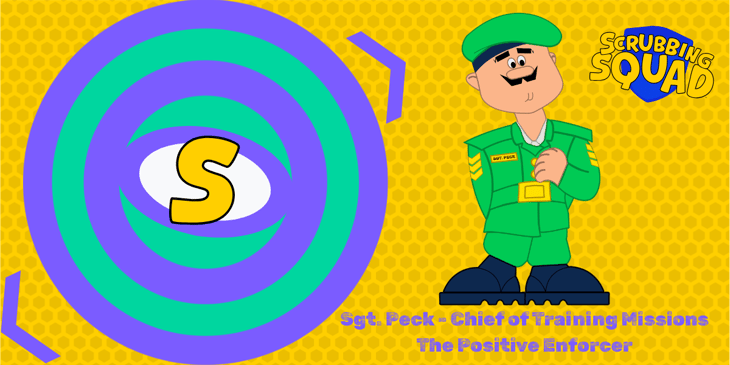
This is Sgt. Peck's ground. He is our Chief of Operational Reality. His mandate is to structure daily habits into missions requiring precision, sequencing, and logical completion. He does not entertain. He deploys.
Sgt. Peck's design philosophy is built on a single principle that Piaget proved and the app industry ignored: from age seven, the child's brain is ready for operations. Give it operations.
Here's how that translates into product.
The SOP Cards are Standard Operating Procedure cards. Physical. Tactile. Sequenced. Each card contains a single step in a multi-step real-world mission: brush teeth, pack bag, check weather, put on shoes. The child arranges them in order. Completes them in order. Logs completion in order. This is concrete operational thinking applied to the morning routine. Classification. Sequencing. Reversibility. Logic in the child's hands, not on a screen.
The Ritual Mastery Deck takes this further. It provides cognitive ordering challenges that adapt in complexity as the child progresses. Not through gamification. Through genuine operational difficulty. The tasks get harder because the child's brain is ready for harder. Not because an algorithm decided to make the badge shinier.
The Squad Access Key is the daily authentication ritual. Tap the card. Clock in. The mission is live. No animated fanfare. No celebratory sound effect. Just a clean confirmation that the system is active and the child is in command. Logic. Not noise.
And the Sovereign Brain tracks mastery, not speed. It measures whether the child completed the operation correctly, not how fast they tapped the screen. Evidence of Effort. Verified. Piaget-compliant. Built for the brain the child actually has at seven, not the brain the app industry wishes they still had at four.
For Schools and Institutions
If you're a Head Teacher or a curriculum lead, here is the audit question:
Is your digital provision developmentally differentiated between Key Stage 1 and Key Stage 2?
Because if the same app, with the same design logic, the same reward mechanics, and the same visual language is running in both Year 1 and Year 5, you are using a preoperational tool for concrete operational children. The science says that is not just unhelpful. It actively disrupts the learning experience.
Our Administrative Shield will provide Ofsted ready evidence that the digital environment is calibrated to the child's developmental stage. The Evidence of Effort ledger does not reward tapping. It verifies operations. Classification. Sequencing. Real-world task completion. Measured against each child's own baseline, not a generic benchmark designed to make the dashboard look good.
Piaget told us seventy years ago that the child's brain reorganises at seven. The research has only deepened since. It is time the products caught up.
Your child's brain upgraded at seven. It moved from magic to logic. From spectacle to structure. From believing that closing your eyes makes things disappear to understanding that the world operates on rules, sequences, and categories.
And the app on their tablet is still flashing, still beeping, still treating them like a toddler.
The Concrete Operational Stage is not a theory. It is one of the most validated frameworks in developmental psychology. It tells us, with seventy years of evidence, that children aged seven to eleven learn through logical operations on tangible, real-world problems. Not through animated rewards. Not through badge explosions. Not through extraneous noise designed to keep them tapping.
We are building a platform for the brain the child actually has. Logic. Structure. Physical operations. Real-world missions. Verified mastery.
Flash fades. Logic compounds.
Building for 10 million heroes.
Heroes Start Here
Join the hero community: Sign up at scrubbingsquad.com and be the first to get exclusive access for your Heroes.