


Your child is not broken. I need you to hear that before we go any further.
The child who can't sit still. The child who melts down at bedtime. The child who won't put the tablet down. The child who seems "addicted" to a screen. The child whose teacher says "lacks focus." The child you've Googled symptoms for at 1am because something feels wrong and you can't name it.
That child is not broken.
The system they're living inside is.
The Attention Economy Has a Name. Your Child Knows It as Tuesday.
In 2016, a former Google design ethicist called Tristan Harris made a simple claim that changed the conversation about technology: the products on your phone were not designed to help you. They were designed to capture your attention and hold it for as long as possible, using the same variable reward mechanics that make slot machines addictive.
He went further. He told the US Senate that digital platforms operate within an attention economy, where companies prioritise user engagement to maximise advertising revenue, often at the expense of psychological wellbeing. Platforms deploy persuasive design techniques to capture and retain attention, transforming users into unwitting participants in a system engineered for prolonged interaction rather than voluntary use.
That was about adults. Now apply it to a seven-year-old.
The 5Rights Foundation, a UK child safety body, published research titled Disrupted Childhood: The Cost of Persuasive Design. Their finding was devastating: the apps children use daily are loaded with persuasive design features including rewards, character pressure, and aesthetic manipulation specifically calibrated to extend session time.
Harris himself put it plainly: "These technology products were not designed by child psychologists who are trying to protect and nurture children."
They were designed by engagement engineers whose KPI is session duration. And the children using them are not customers. They are the product.
What the Attention Economy Does to a Developing Brain
A 2024 study published in Children (MDPI), examining screen exposure in typically developing children aged 6 to 10, found that children with 2 hours or more of screen time had more screen addiction than children with less screen time and that there are more attention deficits in typically developing children aged 6 to 10 years who have more screen time.
Typically developing. Not diagnosed. Not neurodivergent. Children with no clinical condition whose attention is being measurably degraded by the environment they are placed in.
A comprehensive review published in Cureus (2023) documented that sleep issues, excessive screen time, and exposure to content that is violent and fast-paced trigger dopamine and reward pathways in the brain, all of which have been associated with ADHD-related behaviour.
Astonishing right! The behaviour looks like ADHD. But the cause is the environment. The child is not disordered. The child is responding predictably to a system designed to hijack their dopamine response.
And research from Lurie Children's Hospital (2025) confirms what every parent already feels: more than half of parents, 54%, have felt their child is addicted to screens. Other top concerns include reduced attention spans, disrupted sleep, behavioural issues, lower levels of physical activity, and weakened social skills.
54% of parents. That is not a niche concern. That is a majority of families living inside a system that is actively working against their child's development.
The Guilt Trap
Here's where it gets personal. Because the attention economy doesn't just harm your child. It blames you for the harm.
"Set screen time limits." "Be more consistent." "Have you tried a reward chart?" "Maybe they need more outdoor time." "Have you spoken to the school?"
Every piece of advice assumes the problem is you. Your parenting. Your consistency. Your boundaries. Your follow-through.
None of it addresses the fact that there are, as Harris described, a thousand engineers on the other side of the screen whose job it is to break down the self-regulation your child hasn't even finished developing yet.
You are not competing with your child's willpower. You are competing with a multi-billion-pound industry that deploys variable ratio reinforcement schedules, infinite scroll mechanics, and dopamine feedback loops against a brain that won't finish maturing until their mid-twenties.
And then you're told it's your fault when they can't put the tablet down at bedtime.
That is the guilt trap. And it is a lie.
Your child is not failing. The system around them is failing. And you are not a bad parent for struggling inside it. You are a rational adult overwhelmed by an irrational environment that was engineered to overwhelm.
Take Sarah. Take Emma.
Sarah is one of our parent personas. She's the Anxious Improver. She reads everything. Tries everything. Buys the apps, sets the timers, follows the advice. And still feels like she's failing because her seven-year-old can't transition from screen to dinner without a meltdown.
Sarah is not failing. Sarah is parenting inside a system that was designed to make the transition as hard as possible. The app her child uses doesn't want the child to stop. It wants the child to stay. The meltdown is not a parenting failure. It is the predictable output of a product optimised for retention, used by a child whose prefrontal cortex cannot override the dopamine loop without adult support.
Emma is our Specialist-Advocate. She has a child with additional needs. She's been told her child's screen dependency is "part of the condition." She's been told to "manage it" with reward charts and verbal reminders. Nobody told her that the app her child uses was built with persuasive design mechanics that exploit exactly the cognitive vulnerabilities her child already has.
Emma's child is not more "addicted" because of their diagnosis. They are more vulnerable to a system that was built without their neurology in mind. The product is the problem. Not the child.
What We Are Building Instead
This is why the Scrubbing Squad exists.
Not as another app competing for your child's attention. As the opposite. A platform whose primary design metric is not how long your child stays on screen, but how quickly we get them off it.
We call it the Green Eject. Every interaction with our platform has a built-in exit. The screen's job is to brief the child, issue the mission, and then send them into the physical world to complete it. The moment the briefing is done, the screen locks. The mission happens with physical tools in the child's hands, not pixels on a display.
The tools are part of what we call the Armory. Physical, NFC-enabled hardware that sits inside your child's daily routine.
- The Squad Access Key is a tactile card the child taps to start their day.
- The SOP Cards are physical step-by-step mission cards for morning routines, evening routines, hygiene protocols.
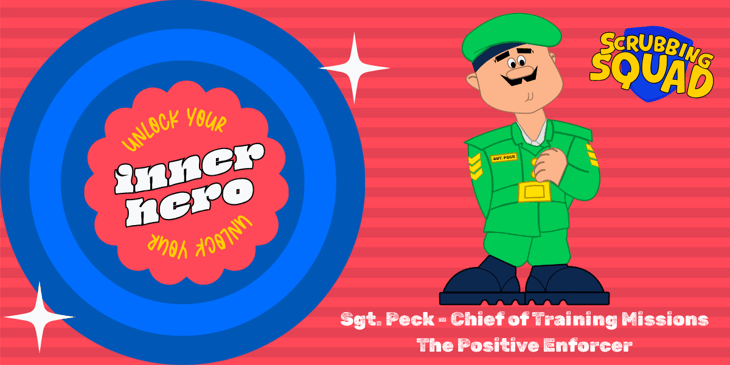
Sgt. Peck, our Chief of Training Missions, builds the mission architecture. Sgt. Keith, our Chief of Wellbeing, runs the health and hygiene protocols within it. The child holds the cards. Completes the steps. Logs the completion. The screen was involved for thirty seconds. The real-world mission took ten minutes.
That is the inversion. The attention economy wants your child on screen for as long as possible. We want them off it as fast as possible. And we engineered every product to make that happen.
The Sovereign Brain stays local on the child's device. It does not upload behavioural data to a cloud server. It does not feed an algorithm. It does not sell attention to advertisers. The child's data belongs to the child. Their developmental record is their own. Not a revenue stream for someone else's quarterly report.
And the Poverty Lock guarantees that this infrastructure reaches every child at identical quality, regardless of income. Because the attention economy hits hardest in low-income households where free, ad-supported apps use more aggressive engagement mechanics to monetise the children who can least afford the developmental cost.
For Schools and Institutions
If you're a Head Teacher, a Trust leader, or a SENCO, here's the question: How many of the digital tools in your provision were designed by engagement engineers rather than developmental psychologists?
If the app measures session duration as a success metric, it is optimised for attention capture. If it uses variable rewards, badges, and streaks, it is deploying persuasive design against the children in your care. If it doesn't have a built-in exit mechanism, it was designed to keep them on screen, not to help them learn.
Our Administrative Shield provides Ofsted - ready evidence that the digital environment in your setting is designed for developmental outcome, not engagement extraction. The Evidence of Effort ledger measures real-world task completion, not screen time. It proves the child brushed their teeth, packed their bag, completed their grounding exercise. Physical output. Verified. Auditable.
That is a fundamentally different proposition to "they used the app for 45 minutes." Forty-five minutes of what? Measured how? Producing what outcome? If the platform can't answer those questions, it shouldn't be in your building.
The Bottom Line
Your child is not broken. They are not "addicted." They are not failing.
They are a developing human being living inside an economic system that treats their attention as a commodity, their dopamine response as a revenue stream, and their developmental vulnerability as a design opportunity.
The Attention Economy did not ask for your consent. It did not consult a child psychologist. It did not consider your child's neurology, their sensory needs, their emotional regulation capacity, or their right to a childhood that isn't optimised for someone else's profit margin.
We built the Scrubbing Squad because we believe children deserve better than that. Not a better app. A better system. One that measures success by how quickly it gets out of the way. One that puts physical tools in a child's hands instead of dopamine loops in their brain. One that treats your child as a hero to be equipped, not a user to be retained.
The system is broken. Not your child.
Building for 10 million heroes.
Heroes Start Here
Join the hero community: Sign up at scrubbingsquad.com and be the first to get exclusive access for your Heroes.