












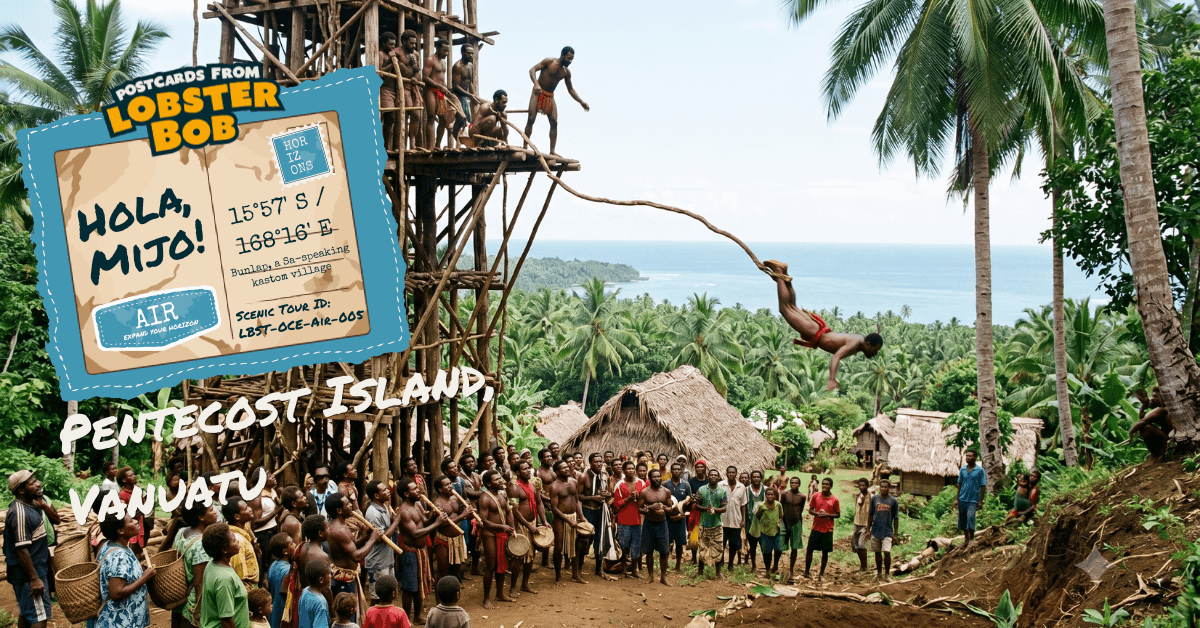
Bunlap. I Had Brought the Wrong Words for What I Was Seeing.
The Destination
This edition returns to Oceania. Lobster Bob is in Bunlap, a Sa-speaking kastom village on the south-east coast of Pentecost Island in Vanuatu. The track is Air. The type is Record. This is the second Oceania destination in the Postcards canon.
The vehicle is El Cóndor YV-528, the Cessna bush plane Lobster Bob has flown across six continents. She landed on a grass strip at Lonorore on the south-west coast. The strip needed a recent trim. She did not comment on the length of the runway. The walk from the strip to Bunlap is a day on foot through the interior.
The men of Bunlap have been jumping from thirty-metre wooden towers with vines tied to their ankles for at least six hundred years. The ritual is called Naghol. The Western world worked out how to copy it forty years ago.
What follows is the postcard from beneath the tower.

Hola Mijo! Lobster Bob here...
We landed on the grass strip at Lonorore at half past nine in the morning. El Cóndor needed a longer roll-out than usual. The grass was high. The strip was acceptable. She did not require an apology.
Lonorore is on the south-west coast of Pentecost. The village I had come to see is on the south-east coast. There is no road between the two. There is a track down the west coast to a place called Salap. From Salap there is a footpath through the interior to Bunlap. The footpath takes a full day on foot. The day is the only honest way to arrive at Bunlap.
I made the walk. I hired a guide in Salap who had done it so many times he had stopped counting. He was patient with the pace. The pace was mine.
Bunlap sits in a clearing near the east coast. It is one of a small number of kastom villages on Pentecost whose people speak Sa and have preserved the way the island worked before missionaries arrived. The villagers wear what their ancestors wore. They speak Sa as the first language. They have decided that the older arrangement is still the correct one. The decision has held for centuries.
The tower had been built in the weeks before we arrived. It was about thirty metres tall at the highest platform. It was made entirely of wood lashed together with vines and rope. There were no nails. There were no struts in the conventional sense. The whole structure leaned slightly forward over the slope where the divers would land.
I had been told what I was about to see. I had read the descriptions. I had watched the documentaries. I still did not understand the structure I was looking at until one of the elders explained how it worked.

The tower is rebuilt every year. The men who build it know exactly which trees to take and exactly how to cure the vines. The vines are the only thing between the diver and the ground. They are measured for each diver. They are cut so the diver's head will touch the soil at the end of the fall. Not before. This is not an approximation. The vines are within centimetres of the diver's actual weight and height.
The first diver was a boy of eight. He had not jumped before. His father went up the ladder behind him to the lower platform. The father did not speak. The boy did not look down. He stepped to the edge. He waited. He jumped.
He hit the soil with his shoulder and the vines pulled him back into the air. The vines had been calculated correctly. The boy was on his feet within seconds. His grandmother was waiting at the bottom of the tower. She held his face in both hands without speaking and then let him go.
I had been ready to react. I had not been ready to be silent. There was nothing to add to what had happened.
The failure was small.
I had thought I understood what I was about to watch.
I had thought of it as extreme.
I had thought of it as brave.
The men of Bunlap do not think of it as either. They think of it as the right way to look after the yam harvest. This is not a metaphor. The diver's shoulder touching the soil is the act that fertilises the soil for the next year. The vines are calculated. The yams require the touch.
I had brought the wrong words for what I was seeing.
The school-yard fact is this.
The Sa-speaking men of Bunlap and the other kastom villages of south Pentecost have been jumping from these towers since at least the fifteenth century.
The ritual is called Naghol. In 1979 a small group of Oxford students watched footage of the jumps. They decided to copy it with rubber cords. They did this off a bridge in Bristol. Modern bungee jumping descended from that copy. It now exists in fifty countries.
The men of Bunlap noted this with an equanimity I am still trying to learn. They have not commented publicly. They built the next year's tower as usual.
A child can hold that on their fingers tonight. The thing that was named in 1979 had been happening in Bunlap for at least five hundred years. Nobody with an English word for it had arrived yet.
My guide walked me back to Lonorore the next day. The walk back was harder. I had less to think about by then. El Cóndor was where we had left her. The grass had not grown noticeably. She took off without complaint.
Cpt. JT Peg was waiting at the airfield in Port Vila with a thermos. I told him what I had seen. I got it wrong twice in the telling. He let me finish anyway.
The World is Your Classroom. Humility is Your Compass. Passport ready, mijo? The world is not going to wait forever.
Lobster Bob, Founder & Scenic Tour Operator
Three Ways to Travel With Us
528 DESTINATIONS. ONE GUIDE.Your child is the missing passenger. Join the waitlist and travel with Lobster Bob before the first tour opens.scrubbingsquad.com



Building for 10 million heroes.
Heroes Start Here
Join the hero community: Sign up at scrubbingsquad.com and be the first to get exclusive access for your Heroes.