










The Poverty Lock: What It Actually Means
The Tuesday Night Calculation
It is a Tuesday night. A mother in Liverpool is at the kitchen table after her daughter has gone to bed. She has a calculator, a stack of bills, and the household budget written in pencil on the back of a Christmas card. The food shop has gone up. The data bundle is finished six days early. The school is asking for a contribution towards the year-six leavers' jumper.
She is doing what millions of parents do every week. She is moving small numbers between small columns and hoping the sum at the bottom does not turn red.
Somewhere on her phone is an app her daughter would love. It costs £6.99 a month. She closes the app store and puts the phone face down on the table.
The Other Tax Children Pay
There is a tax on being a child in a household with less money.
Joseph Rowntree Foundation (JRF) has been quantifying that tax for years. Action for Children has been documenting its frontline cost. The numbers are not abstract. They are children sitting in cold homes, missing school breakfasts, opted out of school trips, and quietly counting themselves as the kind of child who does not get to do the thing.
The hidden version of that tax sits inside the children's app economy. The good apps cost money. The free apps cost a child's attention and sell it back to advertisers. Either way, the household with less money gets less of what childhood ought to come with.
The Scrubbing Squad was built so that this tax does not apply.
What the Poverty Lock Actually Is
The Poverty Lock is not a marketing line. It is not a charity drive. It is not a CSR pillar that gets quietly walked back when the quarterly numbers are difficult.
The Poverty Lock is a legally binding commitment. Each year we increase our donations to our CIO Unlocking Heroes Foundation by year 5 we will commit Fifty percent of all profits from the Scrubbing Squad are returned to children who cannot afford to pay for the platform and other key community and family essentials.
Legally binding means it sits on the legal record of the company. It is not a sentence I can edit when the cap table changes. It is not subject to a future board's appetite for it. It is the architecture of the company. To remove it would require dismantling the company, not the policy.
That is the difference between a promise and a lock.
Why It Is Locked, Not Promised
Most ethical commitments in children's media are promises.
- A promise is a sentence on a website.
- A promise is a quote in a press release.
- A promise survives until the next funding round, the next acquisition conversation, the next board change. When the wind changes, the promise changes.
A lock holds. A lock is on the legal record. A lock is what an investor sees when they read the company's governing documents. A lock is what a parent's lawyer would find if they ever needed to check.
We built it as a lock because we have read enough children's media history to know what happens to promises.
What This Means for Maria Elena
Take Maria Elena. She is the parent I think about whenever I want to test whether a decision we have made is actually fair. She lives in a household where her daughter Valentina, her husband Carlos, and her mother Abuela Rosa all share one phone. The data bundle has to last the month. Every app is evaluated against two gates. Does it eat the data? Will Abuela respect it?
When Maria Elena finds the Scrubbing Squad waitlist, she does not see a paywall first. She sees a platform that has decided, in advance and in writing, that her household is not a discount. Her household is the standard.
If she can pay, she pays the same as any other family. If she cannot, her child gets the same platform anyway, funded by the families who can. Not a stripped-down version. Not a "lite" tier with the good characters locked. The same Squad. The same missions. The same Evidence of Effort record. The same Green Eject.
That is what the Poverty Lock buys. Not charity. Equality of platform.
What This Means for Grandpa John
Take Grandpa John. He is the grandparent who wants to give his grandchildren something that lasts. Something that is not a Saturday toy and a Sunday landfill. Something he can point to, years from now, and say I bought you that.
When Grandpa John buys a Founding Crew Squad gift for his grandchild, the Poverty Lock means something he can see in plain language. Half the profit on that gift funds a Squad seat for a child whose family could not afford one.
His grandchild gets a hero kit. Another child gets the same platform that hero kit unlocks. Grandpa John gets a named role in two hero journeys instead of one.
He does not have to take that on faith. It is on the legal record.
What This Means for the Founding Crew
For everyone else on the waitlist, paying full price, the Poverty Lock means something quietly important. You are not buying a children's app. You are funding the architecture of an inclusive children's platform. Your subscription pays for your child to be a hero and pays for another child to be a hero alongside them.
Every founding crew member gets to be the parent who put their grandchild, or their child, into a Squad that was built on the legal record to include every other child too.
That is the answer to the question every founding crew member quietly asks. Is this thing I am joining actually what it says it is.
It is 110%
What Auntie Ellie Would Say
The Poverty Lock is Auntie Ellie's territory. She is our Chief Strategist and the Squad's moral compass. She is the one who keeps the architecture honest when other people are tempted to bend it for a quarter.
She would put it in one sentence
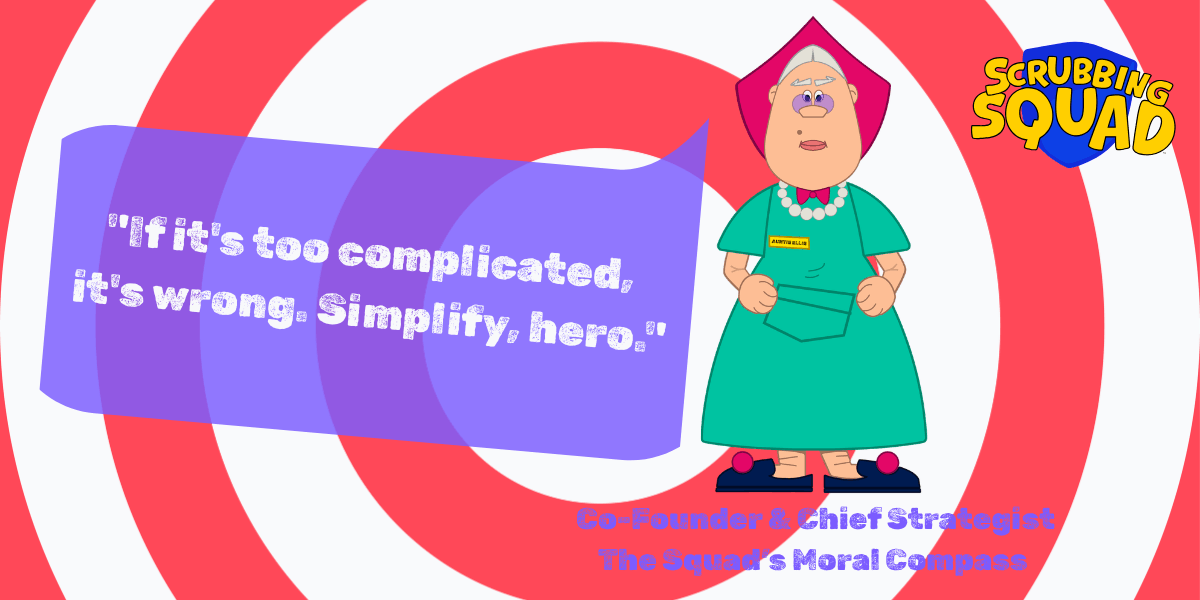
A binding lock on fifty percent of profits by year five is simple. A promise is complicated.
We chose the simple one because Auntie Ellie was watching.
What the Numbers Look Like
The mechanics are not a secret. Every full-price kit and every full-price subscription generates a profit margin. Half of that profit is ring-fenced, by deed, to the Unlocking Heroes Foundation. The Foundation funds Squad access for children whose households cannot pay, including children in low-resource UK households and Title One school settings.
The receipts will be published. The named children will not be, because that is their dignity, not our marketing. But the count will. The aggregate impact will. Year on year. On the public record.
When Maria Elena is sitting at the kitchen table on a Tuesday night with her calculator and her Christmas card budget, she will know that the platform her daughter is on did not require her to choose between the data bundle and her child's developmental record.
When Grandpa John gives his grandchild a Founding Crew gift, he will know it counted twice.
The Bottom Line
We are not asking parents to take our values on faith. We have put them on the legal record.
Fifty percent of all profits by year five. Returned to children whose families cannot afford to pay. Legally binding. Not a promise. Not a CSR slide. Not a brand value that quietly drifts when the company gets bigger.
Locked.
Building for ten million heroes means every child a hero. The Poverty Lock is the bit of architecture that makes that sentence stand up in court if it ever has to.
Building for 10 million heroes.
Heroes Start Here.
Join the hero community. Sign up at scrubbingsquad.com and be the first to get exclusive access for your Heroes.