












You Were Never Going to Win on Willpower
The Five More Minutes Standoff
It is twenty past six on a Thursday. A mother in Sheffield is in the kitchen with the dinner mostly ready. Her seven-year-old is on the sofa with a tablet. She says, "Five more minutes." The seven-year-old does not look up.
She says it again at twenty-five past, slightly louder. The seven-year-old says, "I'm not even doing anything," which is somehow both true and beside the point. She says it again at half past, with the edge in it now, the edge she promised herself this morning she was not going to have today. The tablet comes off the sofa at twenty to seven. There are tears. Someone's are the child's.
This mother has done nothing wrong. She has done absolutely nothing wrong. She has been told she has done something wrong for so long that she has stopped being able to hear that sentence properly. So I am going to write it again.
She has done nothing wrong.
You Have Read the Books
Take Sarah. She is the parent in the kitchen at twenty past six. She is the persona in our system I think about most often, partly because she is the most populous and partly because she is the one who has been worked over the hardest by the children's media industry.
Sarah has read the books. She has tried the techniques. She is the most informed parent her household has ever had. Her own mother did not have the screen battle, did not read the books, did not know the words "limit setting" or "co-regulation," and somehow muddled through. Sarah is doing more, knowing more, and feeling worse.
That gap, between knowing more and feeling worse, is not a Sarah problem. It is a system problem. The system was designed to put her in that gap.
It Was Never Going to Work on Willpower
The screen on the sofa was engineered by some of the best behavioural scientists the consumer technology industry has ever hired. Their job was to make the next minute on the screen the most appealing minute available to a seven-year-old.
They did their job well. Variable reward schedules. Autoplay. Infinite scroll. Notifications timed to the second of peak likely re-engagement. None of this is incidental. All of it was deliberate. The screen on Sarah's sofa is the output of thousands of person-years of attention research.
Sarah was asked to defeat that, every evening, on willpower, after a working day, with the dinner half-done. Two opponents. Sarah's tired voice on one side. A billion-dollar engineering effort on the other. Sarah's tired voice was never the favourite in that fight.
When the dominant intervention the children's media industry has offered Sarah is "set healthy limits and stick to them," what it has effectively offered her is the willpower mismatch repackaged as her personal responsibility.
What the Screen Was Engineered to Do
A child on a screen designed by the attention economy is not "doing nothing." She is being trained, gently and continuously, in three things.
The first is that the next thing is always more interesting than the current thing. The screen is teaching her to leave whatever she is doing in favour of whatever comes next. This is a habit. It travels. It shows up at the dinner table. It shows up in homework. It shows up when her mother asks her to put her shoes on.
The second is that the way to feel okay is to look at something. The screen is teaching her that internal regulation runs through external content. This habit also travels. Sarah will spend the next decade trying to teach her daughter that she can sit with a feeling. The screen will spend the same decade teaching her she cannot.
The third is that adults do not actually mean what they say. Sarah said five more minutes. It was not five minutes. The child knows this. Every child knows this. The screen taught the child to know it.
None of those three things are the child's fault. None of those three things are Sarah's fault.
The Green Eject Is the Architectural Answer
The reason the standoff exists is that nobody else has been willing to build a screen that turns itself off.
The Green Eject is the part of our platform I am proudest of. It is not a parental control. It is not a time limit Sarah has to set and enforce. It is structural. When a mission is verified, the screen ends the session. The child does not have to be told. Sarah does not have to be the bad guy. The platform is the bad guy. The platform is built to be the bad guy.
That changes the whole picture in Sarah's kitchen at twenty past six. The mission has a beginning, a middle, and an end. The end is built in. When the end comes, the platform thanks the child and goes quiet. The screen says goodbye on schedule. Sarah does not have to say it three times.
Sarah did not need a better technique. Sarah needed a different building.
What Sgt. Keith Has to Say About It
This work, the work of regulation, the work of finishing a thing and stepping away from it, is Sgt. Keith's territory. He is our Chief of Wellbeing. Canadian. Former Mountie strategist who learned, the hard way, that meticulous lists do not replace nature, sleep, and a pause to listen to the birds.
He has a line for Sarah. It is the line every parent who has been told they are failing needs to hear from someone who is not their mother and not their husband.
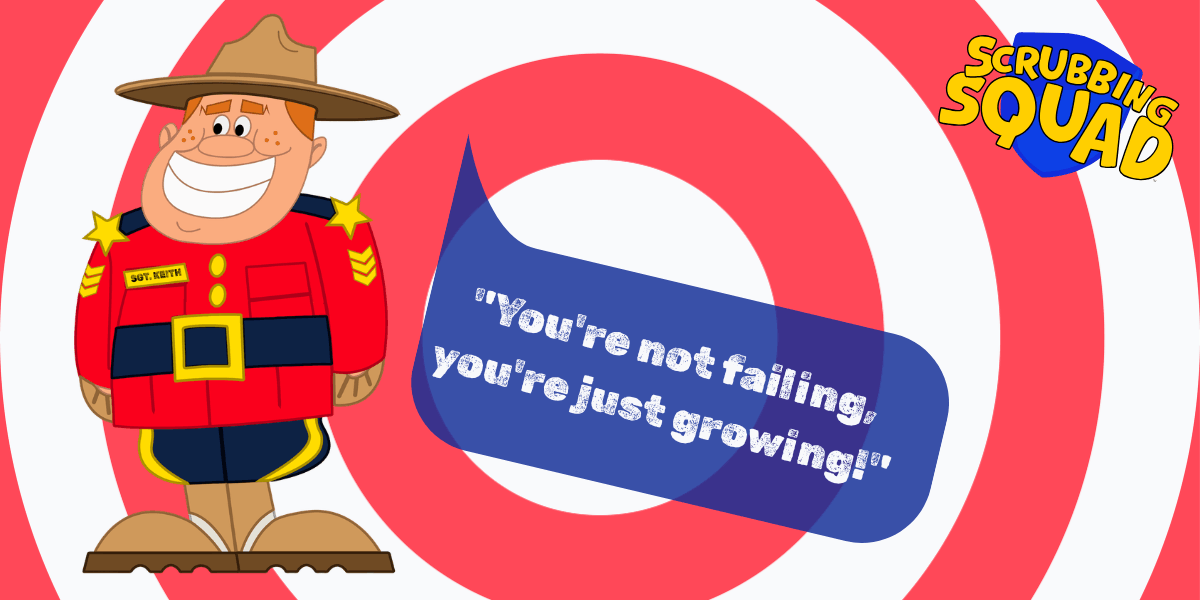
That sentence is for the parent who has been carrying the wrong diagnosis since her first child was old enough to point at a screen.
What This Means for Sarah
When Sarah lets her daughter into the Squad, three things change at twenty past six on a Thursday.
The screen has a finish line on it now, set by the platform, not by Sarah's energy levels. The mission is the unit, not the minute. Sarah does not say five more minutes any more. The mission says how long it is.
The child arrives at the end of the mission on her own. The Green Eject runs. The child puts the tablet down. The child does not put the tablet down because Sarah told her to put the tablet down. The child puts the tablet down because the mission is over and the screen is asking her to go and do something real.
Sarah gets to be the person who calls her in for dinner. Not the person who fights for the tablet. Those are two different relationships with her child, and Sarah was never going to be able to choose between them on willpower.
The Bottom Line
The willpower mismatch was the design. The guilt was the side effect. The parenting books told Sarah to push harder against the design and feel the side effect more sharply.
We built something different. The screen ends the session. The mission has a finish line. Sarah gets to be the kind of mother she has always been trying to be, and was never going to be able to be while she was being asked, every evening, to out-engineer a team of attention scientists on her own.
You are not the problem.
The system is the problem.
We are building a different system.
Building for 10 million heroes.
Heroes Start Here Join the Waitlist
Join the hero community: Sign up at scrubbingsquad.com and be the first to get exclusive access for your Heroes.